
Alright, guardians, pull up a chair and let's have a chat. It's 2026, and I'm still processing a narrative bombshell that dropped way back in Season of the Deep. You know the feeling when you find a perfectly preserved, gourmet cake in the back of your fridge, but it’s four months past the expiration date? That's this reveal. We're now waist-deep in the lead-up to whatever comes after The Final Shape, and I can't help but look back at the moment Bungie gave us the keys to the entire kingdom, but only after we'd already stumbled blindly through the war.
Let’s rewind to mid-2023. Season of the Deep, week five. We were chatting with Ahsa, the giant benevolent space-worm on Titan, and she dropped a cutscene that redefined everything. We finally learned the origin of The Witness, the so-called 'ultimate Big Bad'. The revelation was like an archaeologist finding the Rosetta Stone, only to realize the civilization it belonged to already packed up and left due to a misunderstanding we could have cleared up. It turns out, long before the Hive dug too deep or the Eliksni were graced by the Great Machine, a different people found the Traveler buried on a planet, a disco ball of pure potential sleeping in the dirt.
As these things go, the Traveler, or 'the Gardner' as they called it, blessed them with a golden age. But imagine being given the most sophisticated paint set in the universe without ever being taught the theory of color. They thrived, but they were left gnawing on an existential bone: 'What's the meaning of it all?' So, they did what any knowledge-hungry species would do and sought out the Veil, the universe’s ultimate ontological Dark Side tutorial. Through the Veil, they learned to wield Darkness, and they developed a philosophy so tidy it was chilling. They looked at the Traveler's gifts—life, wonder, but also suffering and unpredictable chaos—and decided to debug the cosmos. Their plan? To link the Traveler and the Veil, forging a connection that would rewrite reality into a frozen, perfect masterpiece without chaos, without death, without life. They called this calcified eternity The Final Shape. The Traveler, a being of pure chaotic good, balked and fled. In a desperate act of unified purpose, that entire race used the Darkness to smelt their collective consciousness into a single, smoke-trail-headed entity to chase it across the universe. That, my friends, is The Witness: a civilization that became a single, obsessively neat knife to cut away the universe's unkempt garden.
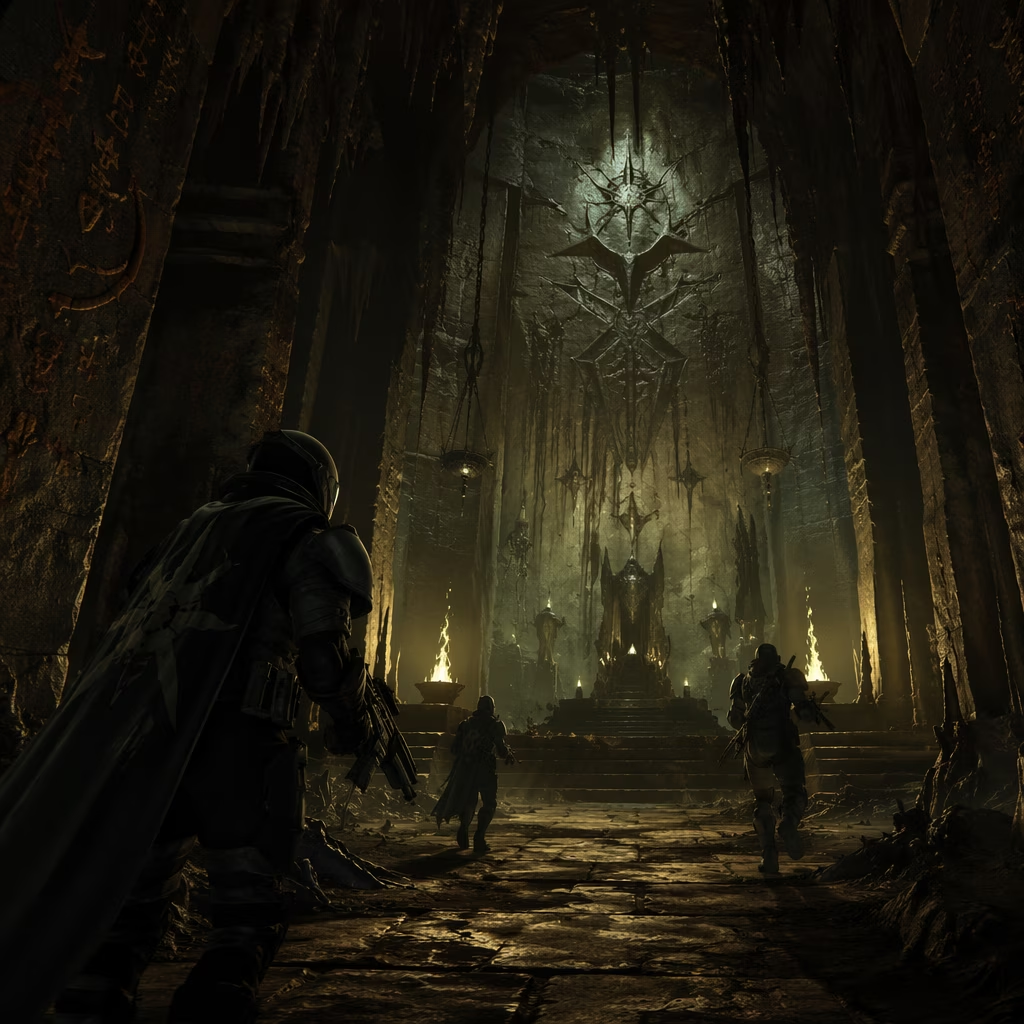
This was a recontextualization of everything, a narrative earthquake that made the lore books shift and settle into a new, sharper landscape. We finally understood the stakes. Lightfall's conflict wasn't just a slap-fight over a glowing orb; it was a desperate attempt to prevent a cosmic surgery that would put existence into an undying, silent coma. The problem? This crucial information was delivered with the timing of a locksmith who shows up four months after you've already broken your door down and had all your stuff stolen.
The entire Lightfall campaign had us sprinting around Neomuna, trading bullets with Calus over The Veil. For hours of gameplay, The Veil was a narrative black box. We didn’t know what it was, what it did, or why we should care beyond the simple equation of 'bad guy wants thing, so we shoot bad guy.' Fighting without this context was like being the goalkeeper in a soccer match where nobody thought to tell you the score or even that a game was happening until the final whistle blew. We failed to stop The Witness from linking with it, and the campaign ended with our Ghost saying some variation of 'Well, that bad thing just happened.' But what bad thing? At the time, the Witness's grand ambition could have been to simply knit a very large, evil tea cozy. The weight of our failure was completely intangible, vanishing into the ether of a story that refused to communicate its own stakes.
Now, this isn't a complete condemnation of serialized storytelling. As a lore enthusiast, I loved the idea of seeing the story progress season over season. But this was a miss of colossal proportion. This reveal wasn't a cool, optional secret about the Exo Stranger's identity we could chew on for years. This was the foundational premise for the campaign we had already paid for and played. To wait 16 weeks into a disposable season—and yes, 'disposable' is the right word here as Season of the Deep has long since vanished into the Destiny Content Vault—to explain why we were fighting is a fundamental storytelling fracture. It’s akin to watching a three-hour whodunit movie, only to have the theater hand you a pamphlet on the way out explaining the killer's motive. Your immediate reaction isn't 'Aha!', it's 'Why wasn't this in the film?!'
This late-game revelation transformed a frustrating, hollow defeat in the Lightfall campaign into a tragic one, but only in retrospect. All we can do is perform emotional time travel, trying to paste our current understanding onto past frustrations. It's a fruitless endeavor, like trying to wet a stamp with yesterday's rain. The year is 2026, and while the story has moved on, the scar remains. This magnificent piece of lore, which recast The Witness as a dark mirror to us Guardians—the original Lightbearers who sought purpose and found it in a sword logic writ cosmic—could have given Lightfall an unforgettable, heavy emotional core. Instead, it served as a post-credits patch note for the narrative, a brilliant cutscene that existed as a monument to a story beat that had arrived dead on arrival. Bungie’s ambition was right, but the execution here was a cautionary tale: you can’t build an expansion's entire emotional arc on a mystery and then mail the solution to us when we've already mentally filed the whole experience under 'confusing waste of time.'
The following breakdown is based on player-facing reference material from GameFAQs, where long-running walkthroughs, FAQs, and community Q&A illustrate how late-delivered lore revelations can reshape (or fail to reshape) the perceived stakes of an expansion after the fact—especially when key terms and objectives are left undefined during the core campaign experience.