
As the gaming world looks toward the latter half of the 2020s, the anticipation for the next major installments in two legendary franchises—Fallout and Destiny—builds like a slow-burning fusion core. While Bethesda's Fallout 5 is not slated to begin earnest development until around 2028, and Bungie's Destiny 3 remains shrouded in whispers and speculation, a common, fervent desire has emerged from their respective fan communities. This shared vision centers on a fundamental evolution of player agency: a radical expansion of the roster of playable characters. This isn't merely a request for cosmetic variety; it's a demand for a deeper, more immersive dive into the rich, factional tapestries that define these worlds, promising to reshape both gameplay mechanics and narrative possibilities.
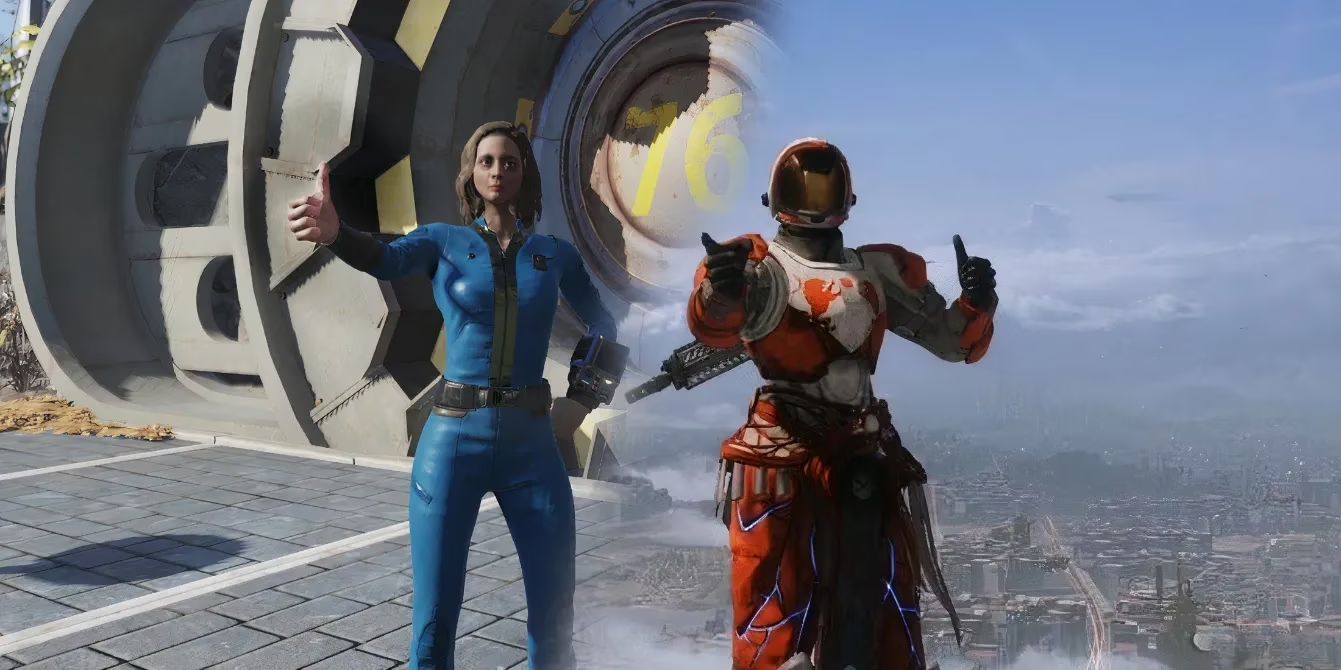
For the Fallout series, the call for diverse protagonists has echoed through the Wasteland for years. The announcement of ghouls as a playable option in Fallout 76 acted not as a conclusion, but as a catalyst, igniting imaginations about what could come next. The franchise now stands at a narrative crossroads, where embracing this feature fully feels less like an option and more like an inevitable destiny. The potential, however, stretches far beyond simply swapping a Vault suit for irradiated skin. The Fallout universe is a sprawling ecosystem of ideologies and mutations, each offering a unique lens through which to experience its brutal poetry.
Imagine not just witnessing the world, but inhabiting it as a member of its most iconic groups. The list of potential playable factions reads like a who's who of post-apocalyptic society:
-
Brotherhood of Steel: Tech-obsessed knights in powered armor.
-
Children of Atom: Zealots who worship radiation like a divine blessing.
-
Enclave: The sinister remnants of the pre-war U.S. government.
-
Institute Synths: Advanced androids grappling with the meaning of consciousness.
-
Super Mutants/Nightkin: Hulking, intelligent beings carrying the burden of their creation.
-
New California Republic (NCR): Soldiers or diplomats of a struggling democracy.
-
Followers of the Apocalypse: Humanitarian scholars preserving knowledge.
Playing an entire campaign as, say, a Legion centurion from Caesar's army or a Mothman Cultist from Appalachia would be as distinct from the standard Vault-dweller experience as a Deathclaw is from a Brahmin. It would force players to navigate moral quandaries, factional hostilities, and survival strategies from a completely alien perspective. The narrative potential is immense—a Super Mutant's journey for acceptance, a Synth's quest for identity, or a Brotherhood scribe's internal conflict between dogma and discovery. This shift could transform the series' role-playing depth, making allegiance more than just a quest choice, but the foundational core of the character's being.
Meanwhile, in a galaxy far, far away, the Destiny universe is undergoing its own quiet revolution, one that makes the introduction of new playable species seem like a logical next step rather than a wild leap. For years, the lines between the Hunter, Titan, and Warlock classes have been deliberately blurred. The Subclass 3.0 updates began this process, democratizing abilities across traditional boundaries. More recently, the introduction of Prismatic Subclasses and Exotic Class items has accelerated this trend, creating Guardians who are less defined by a single class and more by a personalized blend of cosmic power.
Concurrently, the story has masterfully dismantled old enmities. The Vanguard now counts former archenemies like the Cabal Empress Caiatl and the Fallen Kell of House Light, Mithrax, as steadfast allies. The City's walls, once a bulwark against these species, now shelter them. This narrative groundwork is like a carefully laid runway, and new playable characters are the spacecraft waiting for clearance to launch. Why shouldn't a player embody the raw, tank-like strength of a Cabal legionary or the agile, four-armed prowess of an Eliksni Lightbearer?
Introducing playable Eliksni (Fallen) or Cabal could be the master key to solving Destiny's subtle identity crisis, where class distinctions sometimes feel as faint as a ghost's whisper. It would be a monumental shift, injecting proper RPG lineage into the franchise's veins. Story missions could explore the profound alienation and wonder of a Cabal experiencing the Traveler's grace for the first time, or an Eliksni reconciling its people's violent past with a peaceful future. Gameplay would explode with new possibilities:
| Potential New Character | Gameplay Style Preview | Narrative Hook |
|---|---|---|
| Cabal Lightbearer | Slow, heavy-hitting, with unique重型 weaponry and siege abilities. | A warrior learning that true strength lies in protection, not conquest. |
| Eliksni Lightbearer | Fast, technical, utilizing four arms for dual-wielding or enhanced mobility. | A seeker of redemption, mending the scars of the Whirlwind. |
| Awoken Corsair | High-tech, stealth-focused, with Reef-based magic and tech. | An outsider operating in the grey areas between the Queen's law and the Vanguard's. |
Such diversity would be more than a novelty; it would be a renaissance, offering fresh mechanics, weapon specialties, and ability suites that could redefine the combat sandbox.
Ultimately, the parallel paths of Fallout and Destiny toward this feature are fascinating. Both franchises possess worlds so densely populated and lore-rich that limiting the player's perspective to a single, "default" archetype feels increasingly anachronistic. Expanding the playable roster is the natural, almost gravitational, next step for their evolution. It’s a chance to let players not just visit these worlds, but to truly live as their most extraordinary inhabitants—from the irradiated husks of the Capital Wasteland to the ether-drinkers of the Last City. As 2026 unfolds and the distant silhouettes of Fallout 5 and Destiny 3 begin to take shape, this shared fan dream stands as a beacon, pointing toward a future where our roles in these beloved universes are limited only by imagination.